
Maryville Previous Resident Sources
A backward address trail uses several records because each answers a narrow question. TPAD supplies a present parcel anchor. The Register of Deeds supplies book/page references and legal instruments. City directories and census schedules can show dated household evidence. Sanborn maps describe a structure or use at the map date. Blount archives and local newspapers can add tax, probate, notice, and record-history context. None of those sources alone establishes every previous resident of a Maryville address.
| Source | Years it covers | Where held | What it shows |
|---|---|---|---|
| Blount deed index, historical reel | 1794–1868 direct/reverse; 1869–1891 direct/reverse | TSLA microfilm reel 148; county deed books and Register office | Grantor/grantee navigation. These reel dates are not a verified online cutoff. |
| County tax rolls | Estimated 1846–2003 | Blount County Records Management & Archives | Tax and account context, not household occupancy. |
| Combined city directories | 1923; 1929/30; 1941; 1943; 1948; 1952; 1953; 1959; 1965; 1990; 1991 | TSLA F444.M38A; library and society leads | Dated name-and-address snapshots with major gaps. |
| Federal census | Blount 1830–1880 and 1900–1930; public release follows the 72-year rule | TSLA, library, FamilySearch, and NARA routes | Household at an enumeration date; boundaries and schedules need checking. |
| Sanborn maps | 1892, 1917, 1925 verified | Library of Congress | Structure, street, and use context, not names of residents. |
| City code and permit records | Annual reports linked 2011–2026; individual-address coverage not stated | Maryville Codes and public-record request | Ask for an exact address, record type, and date. No public permit index was located. |
Start with the row that matches the question and time. A 1953 address question benefits from the 1953 directory, the 1948 and 1959 editions for brackets, a Sanborn edition for structure context, and the deed chain for legal-interest evidence.
Note: The historical deed-index reel dates describe microfilm coverage, not a verified beginning or cutoff date for an online Register search.
Maryville Previous Residents Begin Here
Build an address identity packet before following names. Search Tennessee Property Assessment Data for the parcel, then preserve the owner display, situs address, mailing address, control map, group, parcel, subdivision, lot, class, sale date, and GIS link when shown. The TPAD form supports basic county-and-search-term lookup; its advanced options include owner name, property address, subdivision, classification, sale-date range, and structured parcel ID fields.
The control map, group, and parcel identifiers help distinguish similar street names or changed address formats. A situs address is the property’s physical address in the assessment record. It is more durable for this work when stored alongside a legal description, but it is still not a list of everyone who occupied the location. Use the Blount County Property Assessor route and the linked GIS map to confirm the parcel context.
Address anchor. Save the control map, group, parcel, map link, and exact address before searching a prior name, so later findings can be tied to the same land.
Maryville Past Residents and Deeds
The Blount County Register of Deeds uses book/page references, such as WD508 Pg 61 or RB2411 Pg32, rather than instrument numbers. A recorded deed may name the parties to a conveyance, identify a legal description, and carry a date or map/parcel reference. It proves a recorded interest in land, not that a named person lived at the Maryville address.
Online access needs care. The county Online Services page points to U.S. Title Search, while the Register FAQ says documents are not online and public computers are available at the office. The inspection did not establish current live index fields, image access, or an online start or cutoff date. Confirm the working route with the Register before relying on online images. If it does not serve the needed record, use the counter, public computers, a title professional, or TSLA microfilm. The county does not perform title searches.
- Use TPAD to capture the current parcel identifiers and the current owner display.
- At the Register, locate the relevant purchase deed by party name, book/page, legal description, date, or map/parcel reference.
- Record the grantor, grantee, instrument type, deed date, book/page, legal description, and stated consideration if it appears.
- Search the seller as a prior grantee, then repeat the sequence while the legal description continues to match the same property.
- When the office index trail ends, use the 1794–1868 and 1869–1891 TSLA direct/reverse index coverage on reel 148 for historical navigation.
- Grantor / grantee
- The grantor transfers an interest in a recorded instrument; the grantee receives that recorded interest.
- Chain of title
- A sequence of recorded interests traced backward through matching instruments. It may require professional title work to be complete.
- Legal description
- The land description in the deed. It is a stronger link between old records and a parcel than a street name alone.
Note: Confirm the live Register route with its office because the county’s online-services pointer and FAQ describe access differently.
Maryville Past Residents Need Dates
The Alcoa-with-Maryville directories are useful but noncontinuous: 1923, 1929/30, 1941, 1943, 1948, 1952, 1953, 1959, 1965, 1990, and 1991 are the verified editions. Use each as a dated observation. A name in 1953 may be compared with 1948 and 1959, but it cannot fill the years in between. The title covers Alcoa with Maryville, so the printed address and page are essential checks.
For older or missing directory years, work outward to census, tax rolls, newspapers, probate, and county records. The Maryville city directory collections route has the title, call number, library, society, and transcription details. It should not be treated as a modern address index.
A practical household flow is: directory edition to exact page, then nearest census, then a newspaper or probate notice when a dated move, death, or estate question remains. Preserve the source’s date at every point.
Maryville Sanborn Maps Set Limits
The Library of Congress has verified Maryville Sanborn map editions from September 1892, August 1917, and August 1925. The 1892 item has one sheet; the 1917 item has 18 sheets; and the 1925 item has 20 sheets. These sheets can show a building footprint, street arrangement, or a structure’s use at the edition date. They do not identify previous residents or prove that a present building, parcel line, owner, or household is unchanged.
Use a map after the parcel and directory date are in hand. A 1925 sheet can give building context for a 1920s listing, while deeds and tax records track legal or assessment context. Maryville Times notices, digitized for 1884–1944, can add a dated public notice around a name or address. Record the issue and page before drawing a conclusion.
Maryville’s history and Ask an Archivist resource is a local route for an old-place question or landmark context.
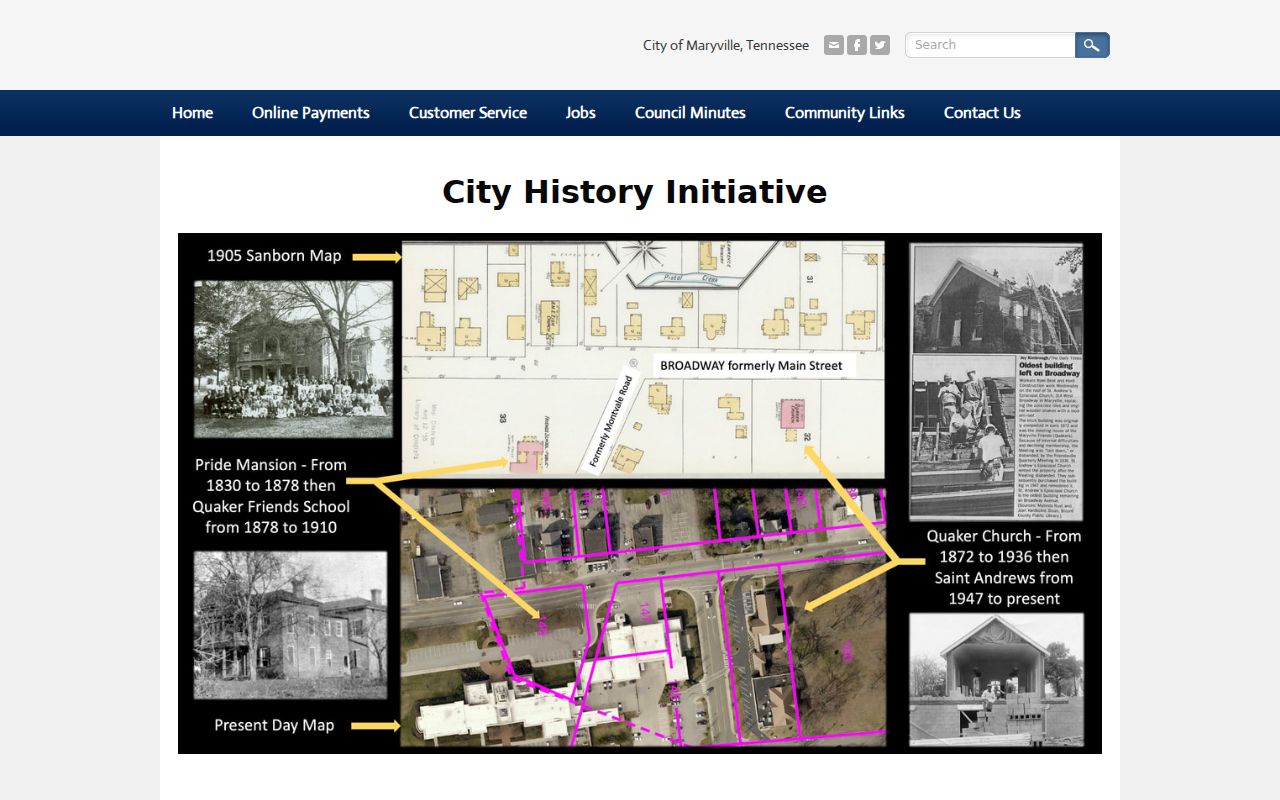
Use the city archivist route to identify historical context, then return to the dated county and library records for the address trail.
Note: A Sanborn sheet records built-environment context on its own date and cannot identify an occupant without a separate dated source.
Maryville Past Residents at Archives
Blount County Records Management & Archives, 1229 McArthur Road, Maryville, TN 37804, holds non-current, permanent, and temporary county records. Its stated scope runs from 1795 to the present, subject to category gaps and confidentiality rules. Call or email for an appointment before an onsite visit: Records Manager and Archivist Joni Seratt is listed at 865-380-4295, fax 865-380-4297, and allrecords@blounttn.org. Hours are Monday through Friday, 8 a.m. to 4:30 p.m.
The archive can supply the records that fall outside an online search: tax rolls, minutes, probate, marriage material, court files, maps, and county records. Copies are $0.50 per page, certification is $5, and amounts under $1 are not charged. The listed payment choices are cash, check, cashier’s check, or money order. Request the address, time range, record type, and any book/page or parcel clues already found.
The county’s Digital Images collection provides historical index and transcription leads.
An archive date range is an estimate for a record category. Ask staff about missing years and the exact volume before treating a gap as a negative finding.
Maryville Previous Residents Worksheet
Keep one row for each dated source. This approach prevents a common error: turning a deed, map, or directory into a claim it does not make. A Maryville previous residents file is strongest when the parcel identity, exact source wording, and limits are kept together.
| TPAD access date | Owner, address, and parcel fields support the assessment display, not every household connection. |
|---|---|
| Deed date | Grantor, grantee, and legal description with book/page support a recorded transfer or interest. |
| Directory year | Printed name and address with edition/page support a listing at that date, not continuous presence. |
| Census year | Schedule and page support an enumeration-time household, not an exact legal parcel. |
| Newspaper date | Issue and page support a published notice, not every unverified statement within it. |
| Map edition | Sheet number supports built-environment context, not a resident name without another source. |
Past Maryville Households in Context
Owners are only one part of an address history. A directory edition or census schedule can provide a household-level snapshot, while a deed stays in the legal-interest lane. Pair the nearest federal enumeration with the exact directory edition, then use probate, obituaries, tax material, and Maryville Times notices to test a move, estate transition, or family connection. If no directory edition exists for the year, say so plainly.
The Blount library and Genealogical & Historical Society are collection-based supports for house history. Ask for city and phone directories, maps, yearbooks, newspapers, family papers, local histories, or microfilm by year. Maryville’s Virtual Archives architecture survey may offer a historic-building lead. No official city permit archive cutoff or utility-hookup database was located, so those remain specific records-request questions rather than assumed online records.
Lawful use. Research on past residents is appropriate for house history, family history, estate questions, and personal curiosity. Do not use a historical address trail to stalk, harass, or harm any living person.